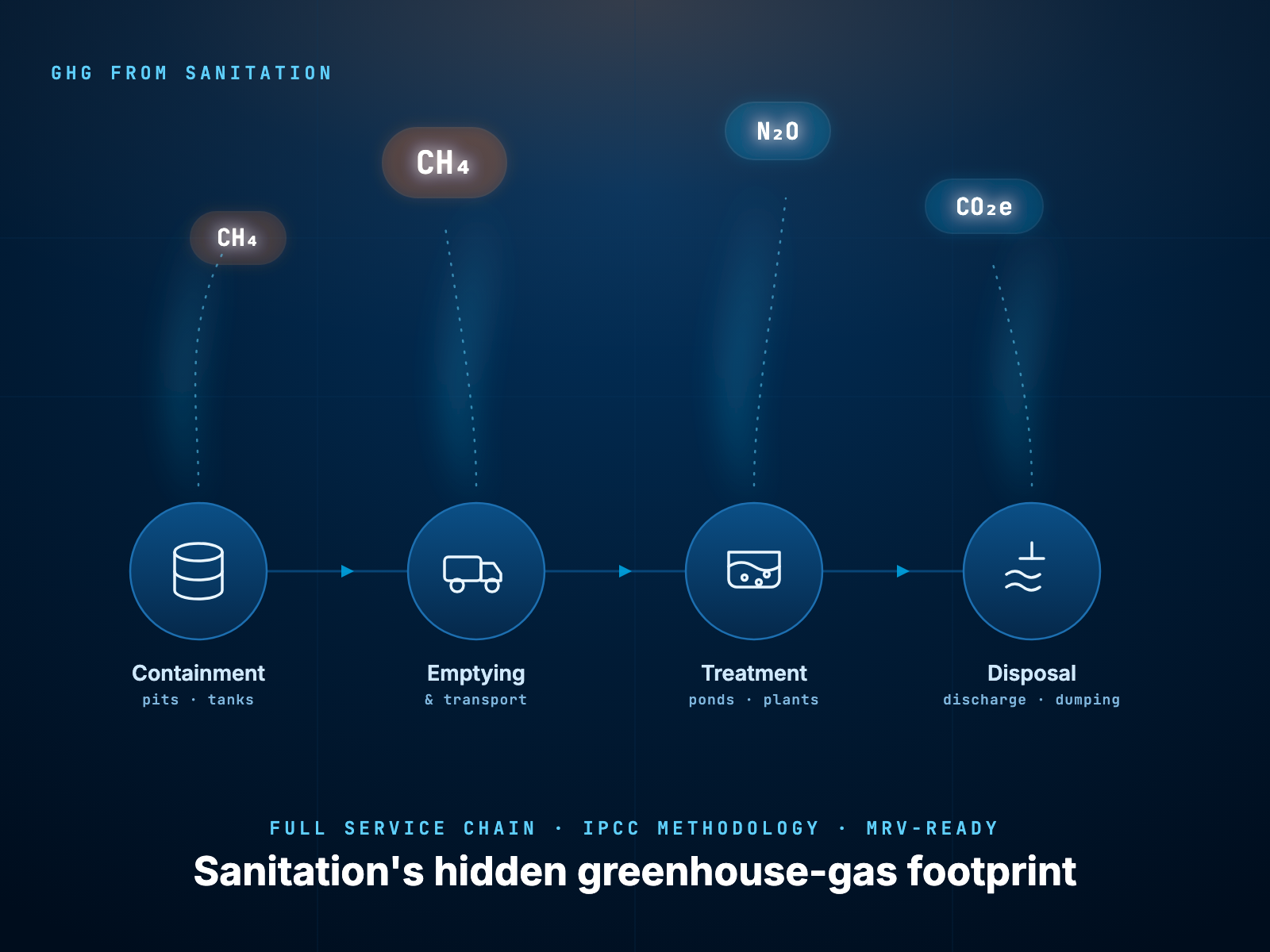
We measure the climate footprint of a country’s sanitation. As human waste is stored, emptied, transported, treated and dumped, it releases methane and nitrous oxide that national climate inventories barely capture. We quantify those emissions across the whole service chain, map them by region and sanitation type, pinpoint the biggest sources, and model how much can be cut with climate-smart sanitation.
Emissions arise at every stage between the toilet and final disposal. We trace each one along the chain.
Pits, septic tanks and latrines generate methane, especially under wet, anaerobic conditions.
Diesel-powered emptying and haulage add operational CO₂ across the collection network.
Ponds and treatment systems emit methane wherever sludge is not fully stabilised.
Dumping, open defecation and nitrogen discharge to water release methane and nitrous oxide.
We apply IPCC Tier 1+ methodology — default emission factors strengthened with national activity data, full pathway disaggregation, and transparent assumptions across the whole service chain.
Outputs built to inform policy, target mitigation, and stand up to scrutiny.
A transparent national inventory combining CH₄, N₂O and CO₂ into a single CO₂-equivalent figure.
A breakdown by region and pathway that shows where emissions concentrate, so mitigation can be targeted.
Business-as-usual versus climate-smart sanitation scenarios that quantify the mitigation opportunity.
Output that feeds national GHG inventories, climate reporting and sector planning.
Quantify the emissions, find the biggest sources, and model the mitigation opportunity for your national programme.
Discuss your project